In recent years, the healthcare industry has witnessed a profound transformation fueled by technological advancements. Among these, artificial intelligence (AI) stands out as a pivotal force driving innovation and efficiency. Generative AI, a subset of AI techniques, has emerged as a promising tool in healthcare, revolutionizing various aspects of patient care, diagnosis, treatment, and research. This article explores the landscape of generative AI platform for healthcare, their applications, challenges, and the potential they hold for the future.
Understanding Generative AI
Generative AI refers to a class of algorithms that enable machines to generate new data or content similar to what they have been trained on. Unlike traditional AI models that are primarily discriminative, focusing on classification or prediction tasks, generative AI models have the capacity to create novel outputs, including images, text, sounds, and even entire scenarios. This ability stems from their underlying architecture, often based on deep neural networks, which learn patterns and relationships from large datasets.
The Role of Generative AI in Healthcare
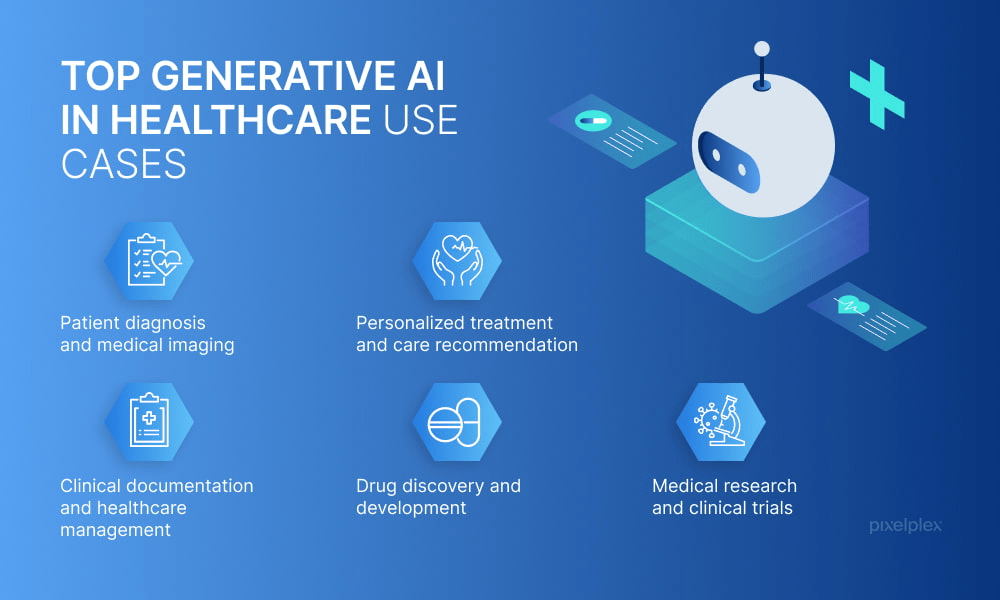
Generative AI has found myriad applications across the healthcare continuum, offering innovative solutions to complex challenges. From medical imaging to drug discovery, patient care to personalized medicine, generative AI platform for healthcare is driving significant advancements in the field. Let’s delve into some of the key areas where these platforms are making a difference:
Medical Imaging and Diagnosis
One of the most impactful applications of generative AI in healthcare is in medical imaging and diagnosis. Generative models can analyze vast volumes of medical images, such as X-rays, MRI scans, and CT scans, to assist radiologists in detecting abnormalities, identifying diseases, and predicting patient outcomes. By leveraging techniques like image synthesis and super-resolution, these platforms enhance the quality and accuracy of diagnostic imaging, leading to more precise and timely diagnoses.
Drug Discovery and Development
The process of drug discovery is notoriously time-consuming, expensive, and complex. Generative AI platform for healthcare is transforming this landscape by accelerating the identification and design of novel therapeutic compounds. Through generative models, researchers can generate virtual chemical structures, predict their properties, and screen for potential drug candidates with higher efficacy and lower toxicity. This approach not only expedites the drug development process but also enables the exploration of new avenues for treating diseases.
Personalized Medicine and Treatment Planning
Personalized medicine, which tailors medical treatment to individual characteristics, holds immense promise for improving patient outcomes and reducing healthcare costs. Generative AI plays a crucial role in this paradigm by analyzing patient data, including genomic information, clinical records, and demographic factors, to develop personalized treatment plans and predictive models. By accounting for the unique genetic makeup and health profile of each patient, these platforms enable healthcare providers to deliver more targeted interventions and optimize therapeutic outcomes.
Natural Language Processing (NLP) in Healthcare
In addition to its applications in medical imaging and drug discovery, generative AI platform for healthcare is revolutionizing healthcare through natural language processing (NLP) techniques. NLP models can analyze unstructured text data from electronic health records (EHRs), medical literature, and patient-generated content to extract valuable insights, automate clinical documentation, and support decision-making processes. By understanding and generating human-like text, these platforms facilitate communication between healthcare professionals, streamline administrative tasks, and improve the overall efficiency of healthcare delivery.
Challenges and Considerations
While generative AI holds tremendous potential for transforming healthcare, its widespread adoption is not without challenges and considerations. Some of the key issues that need to be addressed include:
Data Privacy and Security
Healthcare data is highly sensitive and subject to stringent privacy regulations, such as the Health Insurance Portability and Accountability Act (HIPAA) in the United States and the General Data Protection Regulation (GDPR) in the European Union. Generative AI platform for healthcare must adhere to strict data protection standards to ensure the confidentiality, integrity, and availability of patient information. Robust encryption, access controls, and anonymization techniques are essential to safeguarding healthcare data against unauthorized access and breaches.
Ethical and Regulatory Compliance
The use of generative AI in healthcare raises ethical concerns regarding patient consent, transparency, and accountability. Healthcare providers and technology developers must navigate ethical dilemmas related to data ownership, algorithmic bias, and the responsible use of AI-driven solutions. Moreover, regulatory bodies need to establish clear guidelines and standards for the development, deployment, and evaluation of generative AI platforms in healthcare to ensure patient safety and regulatory compliance.
Interoperability and Integration
The healthcare ecosystem is characterized by a myriad of disparate systems, ranging from electronic health record (EHR) systems and medical devices to telehealth platforms and mobile applications. Achieving seamless interoperability and integration among these systems is essential for the effective deployment of generative AI platforms. By leveraging interoperability standards, such as Fast Healthcare Interoperability Resources (FHIR) and HL7, healthcare organizations can facilitate the exchange of data and insights across different systems, enabling more comprehensive and coordinated care delivery.
Explainability and Interpretability
Generative AI models, particularly deep neural networks, are often regarded as black-box systems due to their complex and opaque nature. As such, ensuring the explainability and interpretability of AI-driven decision-making processes is crucial for gaining trust and acceptance from healthcare professionals, patients, and regulatory authorities. Techniques such as model visualization, feature attribution, and algorithmic transparency can help elucidate the underlying mechanisms of generative AI platforms, enabling stakeholders to understand how decisions are made and assess their reliability and validity.
The Future of Generative AI in Healthcare
Looking ahead, the future of generative AI in healthcare is filled with immense promise and potential. As technology continues to evolve and improve, generative AI platforms will play an increasingly central role in shaping the future of healthcare delivery, research, and innovation. From personalized treatment strategies to predictive analytics, disease modeling to virtual patient simulations, the applications of generative AI are virtually limitless.
However, realizing this vision requires concerted efforts from healthcare organizations, technology providers, policymakers, and other stakeholders to address the challenges and barriers to adoption. By fostering collaboration, promoting transparency, and prioritizing patient-centricity, we can harness the full power of generative AI to usher in a new era of precision medicine, proactive healthcare, and improved patient outcomes.
In conclusion, generative AI platforms represent a transformative force in healthcare, offering innovative solutions to longstanding challenges and unlocking new opportunities for improving patient care and advancing medical research. By embracing the potential of generative AI and overcoming the associated hurdles, we can revolutionize the way healthcare is delivered, ultimately leading to healthier, happier, and more resilient communities worldwide.
 Tech Venture
Leave a comment